Tuesday, June 30, 2009

media release- Back to School- Back to Nature, Aug 1

Media contact: Dolly Cummings
phone: 813-363-5438

2nd Annual Back to School- Back to Nature Event

Saturday, August 1, 2009
9am- noon
FREE but pre-registration is requested.

Easy online registration preferred, click the link at http://www.campbayou.org/ . If you don't have internet access, call Camp Bayou at 813-641-8545 to make your reservation. Be sure to leave your name, number attending, child's grade level and phone number. All children must be accompanied by an adult.

What happens on the morning of the event?

Sign in at the registration table. Kids can then start learning at one of our fun and educational stops on the 'Big Lawn'. After playing an eco-game, or learning to use a GPS or touching a toad, or any one of the many activities at the nature stations, kids receive a free school supply item. Items given out include pens, pencils, looseleaf paper, spiral notebooks, and other useful items. Raffle tickets will be drawn on the half hour for backpacks, Publix Supermarket gift cards and more throughout the morning. Don't worry about missing your raffle number- all winners will be displayed on the board in the registration area. You must, however, claim your prize before 2pm on the day of the event.

Organizations planning to attend include:
South Shore Regional Library
Ruskin Branch Library
Family Support & Resource Center
Keep Hillsborough County Beautiful
Hillsborough County Solid Waste
Florida Department of Forestry
Camp Bayou Nature Center
Paleo Preserve Fossil Museum
to name just a few...

Camp Bayou is a partnership between the Ruskin Community Development Foundation, Inc. and Hillsborough County Parks, Recreation and Conservation. Camp Bayou is located 3 miles south of SR674 at the end of 24th St SE in Ruskin. Visit us on the web at http://www.campbayou.org/ .

###
Pictured: Herb and Sharon Berman talk to visitors about the frog's life cycle at last year's Back to School- Back to Nature Event


Friday, June 26, 2009

Eclectic and Amazing Summer Art Exhibit

Abridged from the Friends of the SouthShore Regional Library email announcement:

Eclectic and Amazing Summer Art Exhibit
During July and August, the Crawford Art Studio at the SouthShore Regional Library is hosting an eclectic fine art exhibit of the Studio's 18 art educators. Each educator is also an active artist. All of the artists are well known in the Tampa Bay area. The "Opening Reception/ Meet the Artists" is Thursday evening July 9 from 6:30-8:00 pm. This event is co-sponsored by the Friends of the SouthShore Regional Library.

Light refreshments will be served. There is no charge for this summer cultural event. Please join us on July 9th. Call Suzanne Prach at 273-3652 for questions.

Wednesday, June 24, 2009

Speak up for Hillsborough County Parks- July 16

From: GatorBob
TO: Outdoor Recreational Enthusiast and Families

SUBJECT: Hillsborough County Regional and Wilderness Parks Are About To Close.

Hillsborough County Board of County Commissioners (BOCC) in their budget public hearing on Thursday, July 16th. Will consider seriously cutting the Hillsborough County Parks, Recreation, and Conservation Department (HCPRC) budget that will leave the HCPRC no choice, but to close some or all of the 14 Regional and Wilderness Parks, serving over 4.9 million visitors like YOU and your family members.

Closures, shorter hours, and opening only for 2 or 3 days a week of these County Parks will seriously affect your access to many of the natural areas within the county where you can SAFELY hike, bike, paddle, or sit quietly reading a good book. I just can’t imagine not having a park to take the grand children for a picnic or summer birthday party. Moms and Dads won’t have access to our park system to teach their children about the pleasures of fishing, canoeing and kayaking or about nature in general.

The Parks Department does a remarkable job of maintaining the 16,500 acres of natural areas in the 14 sites that make up the County Regional Park system.

Currently, every person, regardless of their age, physical abilities, or income has access to our County Parks during daylight hours, seven days a week, 365 day a year

Under the proposed 2010 budget plan, of the 109 full time park rangers and managers, 54 will be terminated that were funded in the last budget cycle. 20 of those positions are currently vacant due to a hiring freeze. With only 55 employees left, keeping up with maintenance like mowing, cleaning rest rooms and emptying the garbage cans will become a challenge, with less security, trail maintenance and overall repairs to the facilities picnic pavilions and nature centers. Further cuts proposed in the 2011 budget cycle, under consideration at this same public hearing, will cut an additional 35 full time regional parks personnel forcing some or all the regional parks to close permanently.

At times when the tax revenue was in surplus, the HCPRC Wilderness and Regional Parks received a pittance increase in their budget. Now that revenues are well below budget, the Parks Department will be hit with a dis-appropriate amount of terminations and reduced funding.

Hillsborough County Regional and Wilderness Parks have been featured all over the world and are well known as some of the finest natural areas in Florida , if not the United States . Appearing in TV commercials, movies, travel magazines and newspapers has made our parks “a have to” travel destination, supporting the 16 million visitors annually to Hillsborough County who spend 1.3 billion dollars in our local businesses. The unintended consequences of neglecting our natural areas, preserves and parks will not only impact our recreation, but have a devastating effect on our local economy and the very jobs that support our families. NOW is the time to let YOUR voice be heard.

SIGNUP TO SPEAKUP;
July 16th. County Center , Commission Boardroom, 2nd floor, 601 E. Kennedy Blvd , Tampa , STARTING at 6PM.
If you cannot personally attend, then send a postcard or letter to BOCC Budget Hearing, P.O. Box 1110, Tampa, Florida, 33602 OR E-mail your Commissioners at; hcbudget@hillsboroughcounty.org . Do a friend a favor and tell them what’s happening by sending them a copy of this E-mail.

Friends of Uzita Heritage Park


Friends of Uzita Heritage Park
The first organizational meeting of the Friends of Uzita Heritiage Park will be held Wednesday July 15 from 6pm to 8pm in the large meeting room at the SouthShore Regional Library located at 15816 Beth Shields Way Ruskin, FL 33573. "Join Today" and lets create a Hillsborough County Uzita Heritage Park.

500 years ago Florida ’s “first people” were more effective in managing the natural environment in this area than we are today, with all our knowledge and technology. Seagrass beds in the Aquatic Preserve are being destroyed daily with no end in sight. Budgetary restraints are threatening to lock the gates to the citizens. Creating the Uzita Heritage Park will better preserve for future generations and bring us all back into harmony with nature today.
For more info ontact Gus Muench at baychopgus@tampabay.rr.com

Monday, June 22, 2009

Ruskin History Center Reopens

From: Fred Jacobsen- Ruskin History Project

fred@GoThere.com


Ron Leybovich

Fifth/Third Bank

1020 US Hwy 41 N

Ruskin 33570

813 641-1421


The staff and management of the Ruskin Branch of Fifth/Third Bank are holding an open house to mark the installation in their lobby of the "first 16 feet" of Ruskin's history. The Ruskin History Project so far is comprised of two 2 X 4 cases containing photos and artifacts from Ruskin's' past in a timeline that runs from the early ice age to the present era. Fred Jacobsen and Dr. Arthur "Mac" Miller started the Ruskin History Project as a way to save and to share Ruskin's history with all the citizens of Ruskin. Miller is the grandson of one of the founders of Ruskin. "The hope is that one day this little history display might grow into its own building or perhaps be located in a community center."


Bank Vice President and Branch manager Ron Leybovich says "the Ruskin history display is a welcome addition to the bank. We hope to sponsor more coffees for the community, perhaps quarterly to encourage discussion and sharing of Ruskin's history."


The Ruskin History Project can be found online at www.RuskinHistory.org


Coffee and donuts will be served at Fifth/Third Bank from 8 am to 9 am Friday July 3. The bank is located at 1020 US Highway 41, Ruskin, on the corner of 11th Ave. NW .


###


Saturday, June 20, 2009

The summer 2009 issue of the Camp Bayou Buzzzzz! is now online

Pictured is one of several activities highlighted in this issue of the Camp Bayou Buzzzzz!


The summer 2009 issue of the Camp Bayou Buzzzzz! is now online at http://campbayou.org/newsletters/2009summer.pdf .

Sunday, June 14, 2009

On the Trail...


Usually I put a little distance between 'On the Trail...' posts but I had to post this photo of a butterfly orchid (Encyclia tampensis), one of several, growing in the huge live oak at Camp Bayou. My camera doesn't have a zoom lens and this one is at least 15 feet above me with tiny cascading yellow flowers.
One of only 2 orchids that naturally live this far north (most Florida orchids live in the deep, deep south), and poached out of most areas (collection in the wild is illegal), it is no longer a common sight in such an accessible place. Check it out before the blooming ends in early July.

Friday, June 12, 2009

On the trail...


The hog plum is in bloom all over the preserve. The pungently sweet aroma greets you as soon as you arrive. Take a stroll but be on the alert for, ironically, the family of feral hogs that have left increasingly destructive indicators of their presence. The mama tends to be very protective of her piglets...

Tuesday, June 9, 2009

On the trail


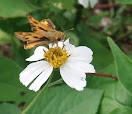
Gopher apple (top) in bloom and shiny leaf blueberry (bottom) with fruit in various stages of maturity, are now a common sight along the Tortoise trail.


Sunday, June 7, 2009

Camp Bayou Pollinator Walk

Thank a Pollinator Today

Saturday, June 27, 2009
9:00am-10:00am

Pollinator Walk
Guided walk through the 'Butterfly Habitat' with a stop at the Native Plant Nursery and Demonstration gardens for pollinator appreciation ideas to bring home. This walk is suitable for all ages. In addition to butterflies, we will look for bees, moths, hummingbirds and any other sipper of fine nectar or pollen collector. When the walk is over, enjoy a snack made possible by pollinators!
Program fee is $1, limit 20 people.

For more information on the importance of pollinators and activities you can do at home, visit http://www.pollinator.org/. This is a Pollination Week 2009 event. Check out the video at http://www.youtube.com/user/PollinatorPartnershi .

Camp Bayou is neither a campground nor a daycamp, but a community resource open to the public, Thursday- Saturday from 9am-2pm. It is funded through grants, donations, membership, volunteers and program fees. Camp Bayou is located 3 miles south of SR 674 at the end of 24th St SE in Ruskin. Camp Bayou is a partnership between the Ruskin Community Development Foundation, Inc. and Hillsborough County Parks, Recreation and Conservation. Visit online at http://www.campbayou.org/.

More-
Why should we thank a pollinator?
Pollination is vital to our survival and the existence of nearly all ecosystems on earth. 80% of the world's crop plants depend on pollination. Pollinators, almost all of which are insects, are indispensable partners for an estimated 1 out of every 3 mouthfuls of food, spices and condiments we eat, and the beverages we drink. They are essential to the fibers we use, the medicines that keep us healthy, and more than half of the world's diet of fats and oils. Insect pollinators, including honey bees, pollinate products amounting to $20 billion annually in the U.S. alone.

###
Photo credit: Dolly Cummings
Pictured: Bumblebee collecting pollen


Friday, June 5, 2009

Florida Rivers Month

From FDEP:

State Recognizes June as Florida Rivers Month
-Florida’s rivers play a crucial role in state’s ecological and economical health -

TALLAHASSEE - Governor Charlie Crist recently signed a proclamation honoring June as Florida Rivers Month, recognizing the importance of protecting the more than 50,000 miles of rivers and streams flowing throughout the state. Florida’s famed waterways include the historic Suwannee River made famous by folk musician Stephen Foster, the 310-mile St. Johns River, one of only a few rivers in North America that flows north, and Northwest Florida’s Apalachicola River, which helps supply 90 percent of Florida’s oysters by feeding Apalachicola Bay.

“From our rivers and streams, to our lakes, aquifer and coastal waters, Florida is blessed with some of the world’s most magnificent waterbodies,” said Department of Environmental Protection (DEP) Secretary Michael W. Sole. “We remain committed to restoring and protecting our precious waterways, and encourage all residents and visitors to do their part in protecting our waters.”

Floridians can help protect Florida’s treasured rivers and streams by practicing water conservation habits in their homes and yards, which can be as simple as turning off the faucet while brushing or not running sprinklers on rainy days. By practicing “green” gardening techniques, such as reducing fertilizer use or spreading mulch to prevent erosion, residents can improve the quality of the waters near their homes.

To provide more information on the state’s ongoing efforts to protect its waterways, DEP recently launched an interactive Web site for citizens to learn more about the waterbodies in their communities, the ongoing restoration activities associated with them, and ways each and every one of us can help protect these waters. Visit www.ProtectingOurWater.org for more information on Florida’s initiative to protect its rivers and streams.

Through its nationally recognized water quality restoration program, Florida is using the best science available to identify and restore impaired rivers based on the first state law of its kind in the nation. Demonstrating stringent water quality standards, rigorous environmental permitting requirements and a strong commitment to reuse, the state has eliminated nearly 300 discharges of industrial and domestic wastewater into Florida’s rivers in the last twelve years. In addition, Florida has invested $2.7 billion in the last six years to protect the state’s rivers by cleaning up stormwater pollution and improving wastewater treatment.

In addition, since 1990, Florida has acquired more than 2.4 million acres of environmentally-sensitive land to protect water quality in rivers, lakes, estuaries and streams through Florida Forever and its predecessor, P2000. The acreage includes the acquisition of 117,460 acres of natural floodplains and more than 510,000 acres of functional wetlands since July 2001.

During the summer months, residents and visitors alike can go outside and enjoy some of Florida’s most famous rivers, such as:

· Florida’s famed Suwannee River meanders 235 miles from the Okefenokee Swamp in Georgia to the Gulf of Mexico. The Suwannee is the second largest river in Florida in terms of flow, size of drainage basin and length, and supports more than 60 species of freshwater fish. In 2002, Florida launched the Suwannee River Wilderness Trail, a five-year, $10 million public-private partnership to boost the economies of rural communities along the river. The Trail provides visitors an opportunity to navigate 207 miles of the historic Suwannee with convenient rest stops located at one-day intervals along the way. To learn more visit www.floridastateparks.org/wilderness.

· Running through one of the top six biodiversity “hot spots” in the U.S., the Apalachicola River in Northwest Florida supports a remarkable collection of habitats and wildlife. The largest river in Florida in terms of flow, the Apalachicola River stretches 112 miles from the Georgia border to Apalachicola Bay. Together with its tributaries, the Chattahoochee and Flint rivers, the entire river basin drains a 20,000-square-mile watershed. The Apalachicola Bay supplies ten percent of all oysters harvested nationally and is the second largest National Estuarine Research Reserve in the nation.

· A natural wonder, the St. Johns River is one of only a few rivers in all of North America that flows north. From its marsh beginnings in east-central Florida to its estuarine waters at the Georgia border, the St. Johns River stretches 310 miles, making it the longest in Florida. The Wekiva, Econlockhatchee and Ocklawaha rivers are its major tributaries, helping support populations of alligators, large-mouth bass, blue herons and bald eagles. In addition, the St. Johns River plays a key role in Florida tourism and commercial fishing markets.

To learn more Florida’s waters visit www.dep.state.fl.us

To view Governor Crist’s Florida Rivers Month proclamation visit http://www.dep.state.fl.us/secretary/news/2009/05/files/florida_rivers.pdf


-30-

Thursday, June 4, 2009

Saturday is the day to hit the wildlife trails

Following is from FWC but don't forget there are also trails at Camp Bayou ...

For immediate release: June 4, 2009
Contact: Wendy Dial
Photos: Go to MyFWC.com and click on “Newsroom.”

Saturday is the day to hit the wildlife trails

Do you want to venture into unfamiliar territory Saturday to chance seeing something new? Then try Florida’s wildlife management areas, which are underexplored troves of trail-laced waterways, woods, marshes and scrub.
Besides footpaths, they have overlooks, where visitors can glimpse wildlife; and there are boat launches, so people can paddle the many creeks, rivers and lakes throughout the 5.8 million, mostly undeveloped, acres of wildlife management areas (WMAs) and wildlife and environmental areas (WEAs).
The Florida Fish and Wildlife Conservation Commission (FWC) manages these habitats that wildlife call home.
The Great Florida Birding Trail offers another unique approach to wildlife viewing.
Saturday is National Trails Day, so named by the American Hiking Association. While some people will take to more traditional park trails, the management areas and birding trail are often off the beaten path, thereby promising wilder experiences.
Jacksonville and St. Augustine sandwich Guana River WMA. This picturesque estuary is home to countless wading birds. Visitors are apt to spot the roseate spoonbill (look for a pink bird with a beak shaped like a big spoon) along the water’s edge. New sites await those who bring a kayak or canoe to launch along a river or on Lake Ponte Vedra.
“Deep in the southern section of the state is Fisheating Creek, a place that draws rave reviews from paddlers taking to the water trail,” said Jerrie Lindsey, director of FWC’s Office of Recreation Services.
This Lake Okeechobee tributary is home to alligators, not houses. Swallowtail kites fly over the tree-lined banks. Paddlers will like the cool shade too, Lindsey noted.
“Right now is the perfect time to hike here,” FWC biologist Grant Steelman said. “We just burned some acreage, so the hiking visibility is great. You can see turkey and deer.”
The best place to hike there is off State Road 78, south of Lakeport. Canoe and kayak rentals are available at the FWC campground, off U.S. 27 in Palmdale. Steelman said the water level is good after the recent rains.
A trail in the middle of the state is the place to find butterflies. The FWC’s Chinsegut WEA features a butterfly garden and trail and an air-conditioned nature center. Visitors to this Brooksville Ridge spot can see sandhill cranes and wild turkeys up-close and personal, from the garden or from the center’s windows. Center hours Saturday are only from 8 a.m. to 2 p.m. However, you can look for deer and hawks from the hiking trails through the WEA’s Big Pine and Chinsegut tracts during any daylight hours.
If these spots have not whetted your appetite for exploring faraway places, check out the stops along the Great Florida Birding Trail. Babcock-Webb WMA in Charlotte County still has plenty of red-cockaded woodpeckers and purple gallinules (marsh birds). This is one of the WMAs with horse trails.
“In the Panhandle is the famous Apalachicola River WEA, which contains the largest expanse of floodplains forest in Florida,” Lindsey said. “Its nationally recognized paddle trail has four segments. This time of year, Cash Bayou is good for paddling and birding.”
In Central Florida, Three Lakes WMA (lakes Jackson, Marian and Kissimmee) offers boating, while the area’s 29.4 miles of trails offer hiking.
“Either way, you stand a chance of seeing 15 of the top 40 birds in Florida,” said Mark Kiser, a biologist with the FWC’s Wildlife Viewing section. “There are 150 species of birds on the Three Lakes WMA bird checklist.”
Most of the trails are part of the Florida National Scenic Trail. Paths can be wet at times.
Check out one of the other 489 Great Florida Birding Trail sites if you want to stay close to home. Fort De Soto Park in Pinellas County is a good place in the summer. Abundant trails lead away from the swimming beaches and picnic grounds to a variety of trails, paved and not. Summer is a good time to watch beach-nesting birds, but remember to watch your step for eggs, and do not disturb birds nesting in the dunes.
For more information on these and other sites, go to MyFWC.com/Recreation. Pick your wildlife trail adventure for Saturday. Happy trails.
-30-

Wednesday, June 3, 2009

media release- Camp Bayou, Ruskin

UPDATE: Check out the video...

Rebuilding a Village

The Native People's Camp at Camp Bayou was recently given a facelift by the young ladies from Brownie troop 1243 and Junior troop 356, both from Ruskin. The exhibit had been created by three Eagle Scouts a few years ago, but had been showing signs of weathering over time.

Over the course of several Saturdays, a variety of projects were tackled. A new village garden was planted, this time using native vegetation that would typically be utilized by the Natives that lived in the area over 500 years ago. Representative foods such as vegetables, meats and fish, necessarily made of plastic for the extended outdoor display time, were repainted. A general cleaning of debris makes the village look like the inhabitants will be returning momentarily. The hut was re-thatched in places that needed repairs.

The Native Camp is ready for guests- either free informal visits or formal programs requesting a modest charge per person. In addition, the simulated archaeology dig offers visitors the opportunity to be 'archaeologist for a morning'- pre-registration required. If you have a group that would like to schedule a formal program for either the Native Camp or the Archaeology Dig, please contact Dolly at campbayou@yahoo.com or call 813-363-5438.

Camp Bayou is neither a campground nor a daycamp, but a community resource open to the public, Thursday- Saturday from 9am-2pm. It is funded through grants, donations, membership, volunteers and program fees. Camp Bayou is located 3 miles south of SR 674 at the end of 24th St SE in Ruskin. Camp Bayou is a partnership between the Ruskin Community Development Foundation, Inc. and Hillsborough County Parks, Recreation and Conservation. Visit online at http://www.campbayou.org/.

###

more photos for download at: http://picasaweb.google.com/campbayou/NativeVillage#